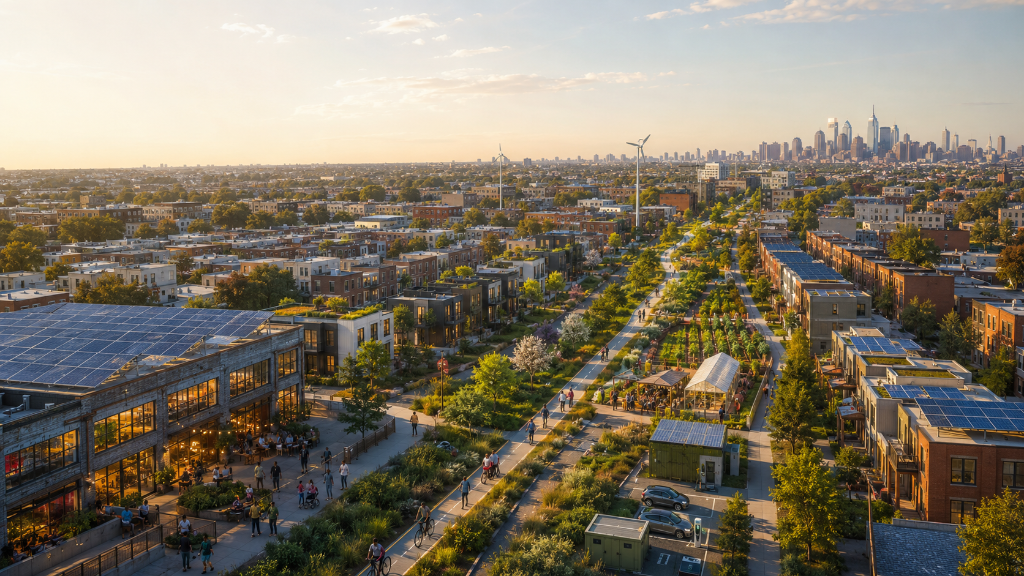
Conceptual aerial view of a green North Philadelphia corridor connecting housing, an orchard, renewable energy, walking paths and community facilities.
Concept renderingAnchor Property Acquired
Rooted in Resilience

North Philadelphia's Green Housing & Community Corridor

Beginning at the acquired anchor property — 193 W. Wellens Avenue — and extending through a former railway corridor, Rooted in Resilience is a community-led plan to connect housing, clean energy, food, technology, workforce development and resilient infrastructure in one coordinated North Philadelphia redevelopment.

Anchor acquired  |  Philadelphia, Pennsylvania  |  Phased planning and feasibility

193 W. Wellens Ave
Anchor property acquired
Approx. 2.5 miles
Initial corridor geography
Housing + Energy + Food + Technology
Integrated development model
Local Learning + Workforce
Community priorities
Phased Feasibility
Current development stage

COUD has acquired the anchor property. Corridor expansion and transaction terms remain subject to definitive agreements, completed schedules, financing, engineering, utility and regulatory approvals.

Community progress · October 2026

COUD Resilient Communities Project

The COUD Community Innovation Corridor is our proposed Logan–Olney initiative connecting affordable housing, green space, food access, community facilities, energy resilience, IT infrastructure and local learning opportunities.

Rooted in Resilience remains part of this community vision. Planning advances in phases, with community needs guiding the work.

A foundation for community development

Documented progress

COUD has acquired its anchor property at 193 W. Wellens Avenue. A Phase I Environmental Site Assessment and predevelopment materials have been prepared. Further environmental review, design, financing and permits remain part of the development process.
Affordable housing and construction planning

Feasibility discussions

Modular housing and precast construction options are being evaluated. Initial responses invite plan review and exploratory discussions. Final unit counts, site layouts, costs and construction schedules depend on engineering, site conditions and approvals.

Broadband and IT infrastructure

Preliminary pricing received

Preliminary pricing has been received for a 10 Gbps dedicated connection at the anchor site. Service routing, survey results, possible construction costs and future expansion still require confirmation. Digital infrastructure is being planned alongside housing, education and community services.

Community energy and water resilience

Concept under study

Planning now includes three coordinated microgrids, renewable generation, battery storage, potential heat recovery and water-management systems. Capacity, safety, utility arrangements and below-grade uses require technical and environmental review.

Greener Logan–Olney

Site-visit coordination

Tree-care and native-planting discussions have advanced to proposed site-visit availability. Orchard education, pollinator habitat and stormwater improvements remain priorities. Planting commitments and funding will be announced when confirmed.

Youth learning and workforce pathways

Program planning

A proposed 2027 youth program connects mentoring, community care, green stewardship and youth-selected learning activities. STEM, creative technology and local workforce opportunities remain part of the broader vision. Launch details depend on funding, qualified staff and site readiness.

Housing stability and family support

Approval preparation

COUD continues preparing its housing-counseling program, intake process, education, referrals and follow-up model. HUD agency approval and counselor readiness remain pending; this update does not announce an approved HUD program or homes available for occupancy.

Community text updates

Messaging verification completed

Toll-free messaging verification for Housing Community Updates is complete. Community messages will be sent to people who opt in, with opt-out instructions. Contact COUD to ask about receiving updates.

Development plans remain subject to site control, environmental and engineering review, permits, financing and agreements. Public announcements will follow confirmed milestones.

For generations, rail corridors carried people, materials and opportunity through Philadelphia. When service ended, many of those long, narrow spaces became barriers between neighborhoods. Rooted in Resilience proposes a different future: turn an underused corridor into connective community infrastructure.

COUD has acquired its anchor property at 193 W. Wellens Avenue. A Phase I Environmental Site Assessment and concept materials have been prepared. Survey, environmental follow-up, engineering, financing and permits remain necessary for development. The approximately 2.5-mile Community Innovation Corridor is a planning area; each segment depends on verified site control and approvals.

This linear geography is the project's advantage. Instead of placing housing, energy, food access, digital infrastructure and community services in isolated locations, the corridor can connect them. Homes can sit near green space and neighborhood services. Renewable generation can serve local facilities before surplus energy is lawfully sold through the grid or other authorized markets. An orchard and market can connect food production with community distribution. Broadband, research and data infrastructure can create new educational and employment pathways. The corridor becomes the shared spine that allows every part to support the others.

One Corridor. Many Connected Systems.

Rooted in Resilience is planned as an integrated development platform rather than a single building project. Each component has its own approvals, financing, design and operating requirements, but the components are coordinated around shared land, infrastructure and community outcomes.

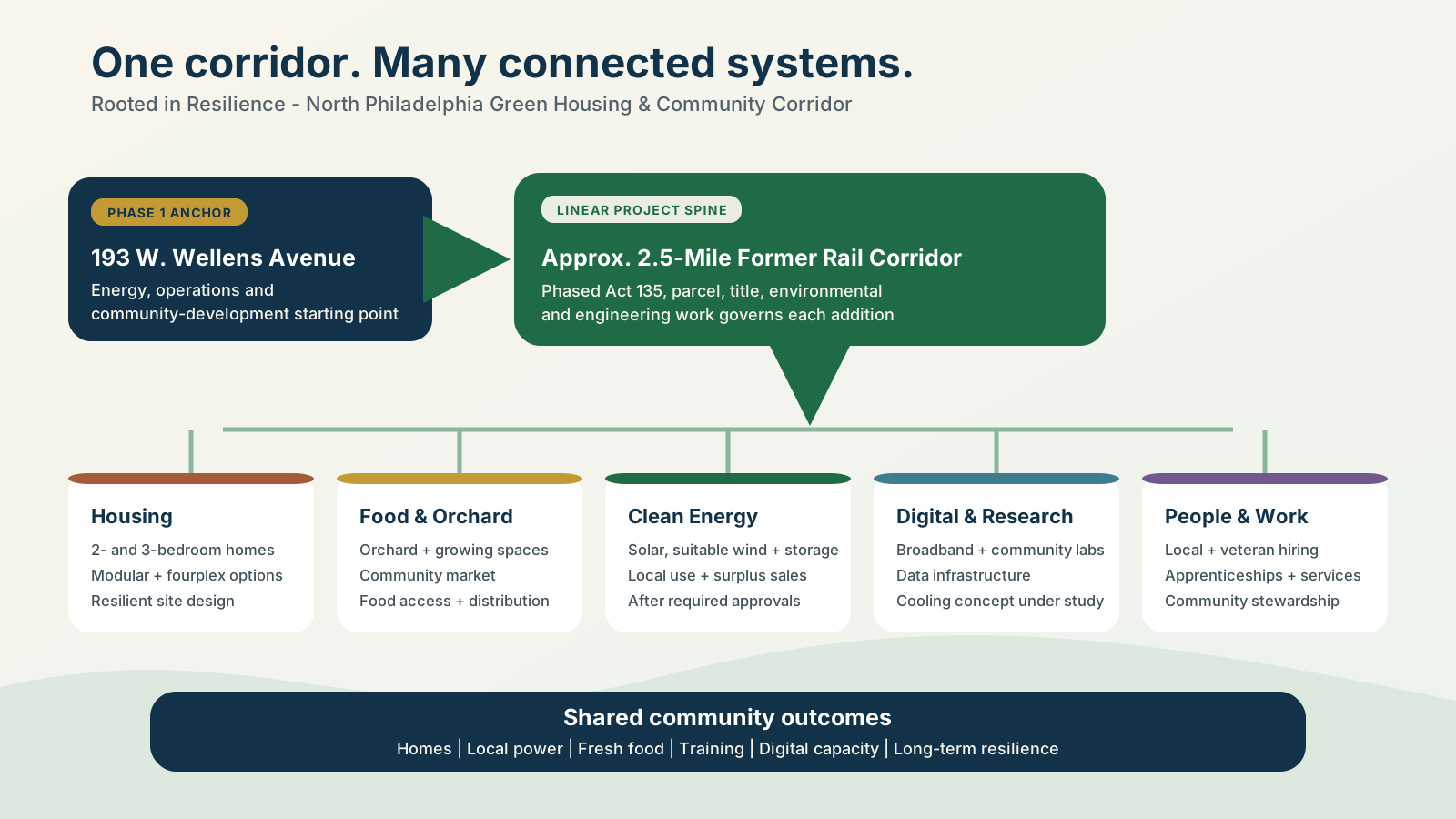
Diagram connecting 193 West Wellens Avenue and the 2.5-mile former rail corridor to housing, food, clean energy, digital research and workforce systems.

System map — 193 W. Wellens Avenue connects through the former rail corridor to five coordinated development systems.

Six Integrated Project Pillars

Each system reinforces the others along the corridor.

Housing

In process

Two- and three-bedroom expandable or modular homes, small multifamily and fourplex configurations, and other buildable housing types selected after Pennsylvania code, site, foundation, utility and financing review. The goal is durable housing connected to green space, transportation access, energy efficiency and long-term community services.

  • 2- and 3-bedroom homes
  • Modular + fourplex options
  • Resilient site design

Clean Energy

Feasibility & transaction development

A technology-neutral renewable-energy portfolio. Potential resources include rooftop, canopy and ground-mounted solar; appropriately sited distributed wind; battery storage; efficiency systems; and other qualifying renewable technologies supported by resource, engineering, safety, permitting and interconnection studies.

  • Solar, suitable wind + storage
  • Local use + surplus sales
  • After required approvals

Three coordinated microgrids are being evaluated; final capacity and arrangements depend on technical review and approvals.

Food & Orchard

Planned — approvals required

The orchard is part of a neighborhood food system that can connect fruit trees, community growing spaces, education, a market, prepared-food activity, storage and distribution. It gives the corridor a productive landscape while supporting food access, intergenerational learning and community stewardship.

  • Orchard + growing spaces
  • Community market
  • Food access + distribution

Digital & Research

Under study

Part of the former rail alignment includes below-grade or underground conditions. Those areas may offer a naturally cooler environment for carefully designed data, research, utility or digital-infrastructure uses. The project is evaluating broadband, community laboratories, resilient communications and data infrastructure.

  • Broadband + community labs
  • Data infrastructure
  • Cooling concept under study

Concept under hydrogeologic, environmental and engineering review. No water-use or cooling claim is final.

People & Work

In process

The project is intended to create a pipeline for local hiring, veteran recruitment, apprenticeships, construction training, operations, food-system work, energy careers, digital skills and long-term facility management. Community benefit is not a side program; it is one of the standards by which each phase should be evaluated.

  • Local + veteran hiring
  • Apprenticeships + services
  • Community stewardship

Housing Counseling & Stability

Agency approval preparation

A planned resident-support system connecting housing education, individualized counseling, financial analysis, action planning, referrals, and follow-up with the corridor's broader housing and community-development work. CUD plans to launch with at least 18 HUD-certified housing counselors under experienced program leadership and grow to approximately 25-30 counselors during the following year, subject to verified hiring, demand, funding, and required approvals.

  • Rental, homebuyer, homelessness & mortgage-default support
  • Tablet-assisted intake and counselor assignment
  • Planned launch team of at least 18 certified counselors
Housing · Food · Community

Homes, Orchards and Community Life

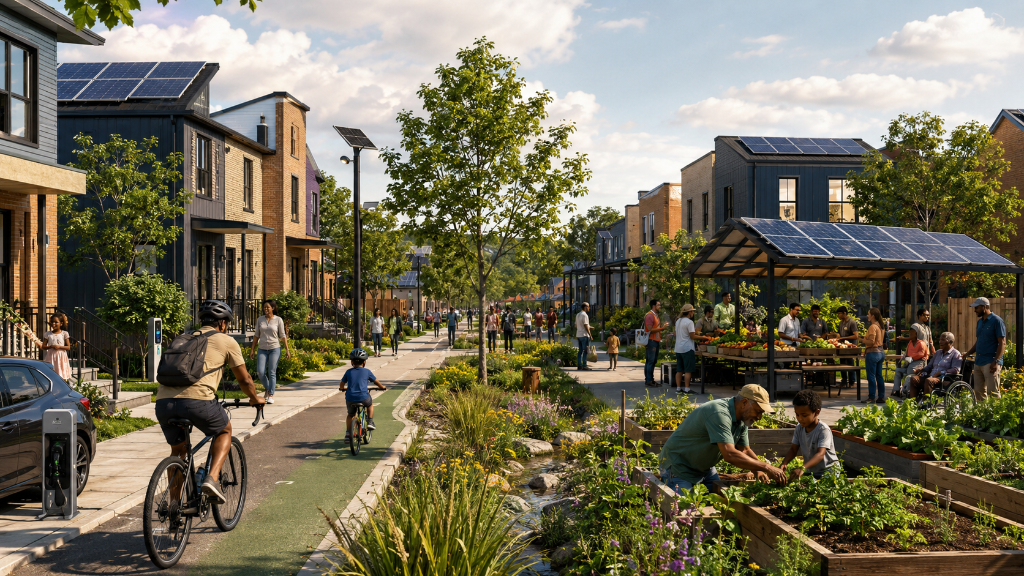
The housing program combines practical, energy-efficient construction with phased neighborhood development. Community growing spaces, a neighborhood market, and prepared-food activity give the corridor a productive landscape while supporting food access and intergenerational learning.

A related community-hub concept at 5223–27 N. 2nd Street may be shown as part of the broader network only with language making clear that final site rights, acquisition and operating plans control.

Note: Where appropriate, renewable energy and rain gardens can help reduce operating costs for food and community programs. Untreated runoff or untested subsurface water will not be used for food production.

Initial Housing Development Concept

The current planning model includes six small multifamily buildings configured as fourplexes, for a potential initial total of 24 residential units. The working target is approximately 1,000 square feet per unit. The long-term operating concept emphasizes durable, energy-efficient rental housing that may serve eligible households through Housing Choice Voucher, Section 8 and other lawful state or federal housing programs.

6
Proposed fourplex buildings
4
Units per building
24
Potential initial units
~1,000
Sq. ft. working target per unit

Disclaimer: These are planning assumptions, not final construction commitments. Building count, unit count, size, tenure, affordability structure and program participation remain subject to legal site control, subdivision, zoning, design, environmental review, utilities, financing, permits, construction review and executed operating agreements. No unit is presently being offered for occupancy.

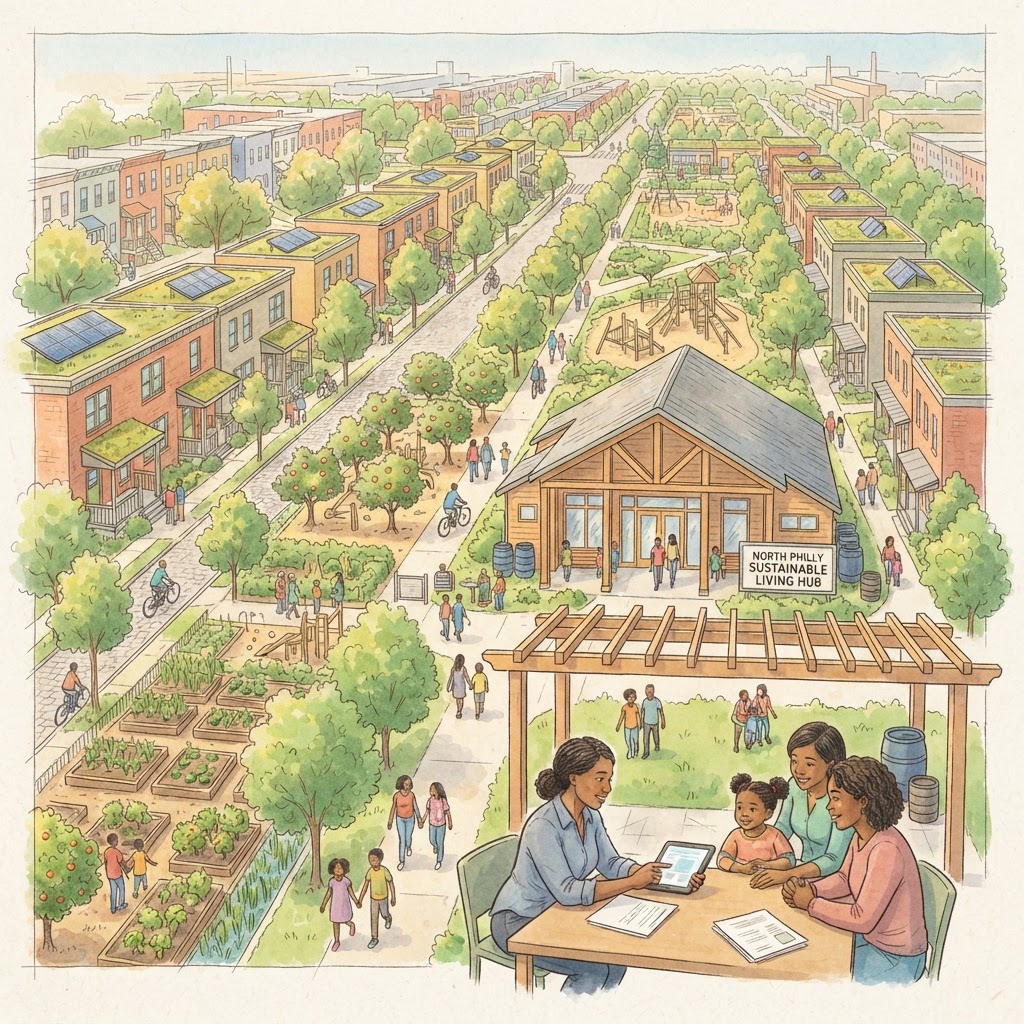
Concept rendering of energy-efficient homes, an orchard, community market, solar power, walking paths and neighborhood residents.Concept rendering

Program status: The Center of Universal Divinity is preparing to apply to become a HUD-approved Local Housing Counseling Agency. CUD is not presently HUD approved. Program activation remains subject to organizational eligibility, staff and counselor verification, CMS readiness, governing approval, funding, and HUD review.

Housing Stability · Counseling · Community Development

Housing Is More Than Construction

Rooted in Resilience is designed to connect the development of physical housing with the professional guidance residents may need to obtain, preserve and successfully maintain housing. The proposed housing-counseling program is the people-centered side of the corridor: it helps residents understand their options, organize their finances, address housing barriers and develop realistic action plans while the larger initiative advances housing, green space, energy, food access, technology and workforce opportunities.

Conceptual North Philadelphia green corridor with modest community housing, trees, gardens, an accessible community facility, residents, and a housing counselor helping a family through tablet-based intake.

Conceptual community vision — not a final site plan, completed development, funding commitment, or government approval.

A Three-Part Housing Ecosystem

PEOPLE

Residents, renters, prospective homebuyers, homeowners at risk of default, families facing homelessness, seniors, persons with disabilities and other Philadelphia households.

SERVICES

Tablet-assisted intake, financial and housing analysis, individualized action plans, education, referrals, counselor follow-up, quality review and outcomes tracking.

PLACES

Existing neighborhood housing, the planned corridor housing, the 193 W. Wellens Avenue anchor, the proposed community hub, green space, orchard, transportation access and related community resources.

The three layers reinforce one another, but counseling remains independent. Receiving counseling does not guarantee placement in a CUD-associated property or require a client to use any particular lender, developer, contractor, product, service or religious program.

From Collaboration to Direct Program Development

COUD's housing initiative builds on community outreach, referrals and housing-stability work. Its planned program connects resident support with the broader community vision.

COUD is preparing its own program documentation and readiness requirements. HUD housing-counseling agency approval remains pending.

Experienced Leadership for the Next Phase

Program leadership and staffing arrangements remain subject to documented onboarding, qualifications, funding and activation. Planned duties include supervision, quality assurance, reporting and staff development.

CUD's current launch plan calls for at least 18 active housing counselors, all HUD certified and each with more than one year of housing-counseling experience. The following-year growth objective is approximately 25-30 counselors. Every counselor's certificate, résumé, screening, appointment, assigned duties and CUD/FHA Connection employment status must be verified before that person is presented as an active CUD counselor.

Staffing Growth Pathway

Historical

Historical Foundation — 2022 Onward

Training, outreach, referrals, housing education and collaborative housing-stability work.

Planned Launch

Launch Model — At Least 18 Counselors

Experienced program leadership, certified counselors, supervised casework, CMS controls and tablet-assisted intake.

Growth Objective

Following-Year Growth — 25 to 30 Counselors

Expansion based on documented demand, funding, quality performance, counselor verification and operational readiness.

Planned Counseling Services

Individual Housing Counseling

  • Homeless assistance and housing-stability planning
  • Rental topics and eviction-prevention support
  • Pre-purchase and homebuyer counseling
  • Resolving or preventing forward-mortgage delinquency or default

Group Education

  • Financial literacy
  • Homelessness prevention
  • Rental education
  • Pre-purchase homebuyer education
  • Mortgage-delinquency education

Final services will be limited to the activities authorized by CUD's approved Work Plan, qualified staffing, applicable law and HUD approval. Services shown here are planned program components, not a representation that CUD is already a participating HUD-approved agency.

Community Outreach · Education · Client Engagement

Meeting Residents Where They Are

Many residents do not seek Housing Counseling by searching for a formal agency. They often first disclose a housing problem to a community leader, faith contact, neighborhood organization, service provider, cultural representative, friend, or family member. CUD's outreach strategy brings Housing Counseling information into those existing trusted networks through repeated, relationship-based engagement with community leaders and representatives.

Outreach is treated as a program function with defined channels, referral pathways, documentation, follow-up, and performance measurement — not a one-time announcement.

Outreach Channels

Social Media

Digital outreach through community platforms and online networks.

Local Radio & TV

Broadcast spots on neighborhood and regional media outlets.

Workshops & Seminars

In-person education sessions at community spaces and partner sites.

Direct Mailers & Flyers

Printed materials distributed through trusted neighborhood channels.

Community Newsletters

Features in civic, faith, and neighborhood publications.

Bulletin Boards

Postings at libraries, community centers, and gathering places.

Fairs & Public Events

Information tables at local fairs, festivals, and public gatherings.

Education & Counseling Curriculum

Pre-Purchase Homebuyer Education

Understanding the path to homeownership step by step.

Financial Literacy & Budgeting

Building strong money habits and sustainable household budgets.

Credit Repair & Management

Improving credit standing and understanding credit reports.

Fair Housing Rights

Knowing your rights and responsibilities under fair housing law.

Foreclosure Prevention

Strategies for preventing or resolving mortgage delinquency.

Sustainable Home Maintenance

Preserving and maintaining housing long-term.

Education topics shown are planned curriculum components. Final services will be limited to the activities authorized by CUD's approved Work Plan, qualified staffing, applicable law, and HUD approval.

Referral Pathways

Residents connect to Housing Counseling through multiple entry points, ensuring comprehensive and continuous support.

Direct Self-Referral

Residents reach out through the website, phone, or in person.

Non-Profit Partners

Referrals from local community organizations and service providers.

Warm Hand-Offs

Agency-to-agency transfers with continuity of care.

Government & Housing Authorities

Referrals from local government and housing agencies.

Lender Partner Referrals

Bank and mortgage lender program referrals.

Tablet-to-Counselor Workflow

1

Welcome and Intake

A resident completes a secure intake online or on a lobby tablet, with staff assistance when needed.

2

Needs and Service Matching

The system identifies the housing concern, language or accessibility needs, and possible duplicate records.

3

Counselor Assignment

The case is routed to the appropriate certified housing counselor and appears on the counselor's managed workload.

4

Counseling and Action Plan

The counselor completes the required housing and financial analysis, discusses options and develops an individualized written action plan.

5

Referrals, Follow-up and Outcomes

The counselor documents referrals, follow-up, progress, outcomes and case closure under supervisory quality controls.

Tablet intake will require secure session controls, automatic logout, removal of the prior user's information, role-based access, audit history and protected document transmission.

Program-Readiness Dashboard

HUD Agency Approval

Eligibility clarification and application preparation

Preparation
Program Director

Appointment accepted; activation pending

Pending
Launch Counselors

At least 18 planned; individual verification required

Planned
Growth Objective

Approximately 25-30 counselors during the following year

Objective
Client Management System

RxOffice under evaluation; final selection pending

Evaluation
Tablet Intake

Workflow planned; configuration and security validation pending

Planned

Community Impact

Residents Served

Tracking our housing-counseling outreach in real time. Numbers update automatically as new service entries are logged.

Total Served
0
This Month
0

No service data logged yet. Check back as our program launches.

Figures reflect service entries logged by program staff. The housing-counseling program is in a preparation phase; counts will begin reflecting active service once the program launches.

Independent, Accessible and Fair Housing-Focused

Planned counseling services will be available without discrimination and without requiring participation in CUD's religious activities. CUD will provide or arrange reasonable accommodations, language assistance and accessible formats. Counselors will give independent guidance based on each household's circumstances. Counseling will not be conditioned on using CUD's developments, lenders, contractors, financial products, partner services or faith programs.

Schedule Your Session

Book Your Initial Housing-Counseling Intake

Reserve a confidential initial intake session with a housing counselor directly from your phone or computer. Choose a time that works for you — in-person at our anchor site, by phone, or via secure video.

30–45 minutes
Video or phone
In-person available

Can't see the calendar above? You can also book directly on Calendly.

Book on Calendly

Booking an intake session expresses interest and helps us prepare for your visit. It does not guarantee enrollment in any program, create a counselor–client relationship, or constitute HUD-approved counseling. Formal intake, eligibility and service decisions occur during the session itself, subject to program capacity and applicable requirements.

OPS-002 / OPS-003

Online Client Intake Form

Complete this secure intake form to begin the housing-counseling process. Your information is transmitted to CUD's housing-counseling team for review. Fields marked with * are required.

Client Contact Information

A

Client Intake — Housing Status

B

Household & Financial Snapshot

Detailed financial analysis belongs in OPS-006. This section is an intake snapshot and should not replace the counselor's documented analysis.

C

Housing Information

D

Initial Document Request / Missing-Document Tracker

E

Agency / Service Disclosure

CUD provides housing counseling and related education/referral services within the scope of its approved program, staffing, qualifications, and available resources. Counseling is intended to help clients understand housing options, financial circumstances, available resources, risks, and possible next steps. The counselor does not make the client's decisions and does not guarantee a particular housing, lending, legal, financial, governmental, or other outcome.

F

Client Rights & Responsibilities

The client is expected to provide information that is accurate to the best of the client's knowledge, notify the counselor of material changes, participate in agreed counseling activities, review the action plan, and make independent decisions. The client may ask questions, request reasonable communication/accessibility assistance, raise a complaint, and decline a referral.

G

Fair Housing, Nondiscrimination, Language & Accessibility

CUD intends to provide services without unlawful discrimination and to provide meaningful access and reasonable service accommodations consistent with applicable requirements and CUD policy. Clients may request language assistance, alternative communication, or reasonable accommodation. Technology is intended to expand access and is not a condition of receiving counseling.

H

Privacy & Confidentiality Notice

CUD will collect, use, maintain, and disclose client information only for authorized program, counseling, reporting, quality-control, compliance, legal, funding, or other permitted purposes. Access to confidential information is limited according to job responsibility and applicable policy. No system can eliminate all security risk; CUD will apply its approved privacy, security, records, and incident-response controls.

I

Conflicts, Organizational Relationships & Referral Choice

CUD may maintain community, referral, professional, governmental, nonprofit, or service-provider relationships. A relationship does not by itself make a provider exclusive. Where appropriate, the counselor will preserve client choice and disclose a material organizational or financial relationship when required by CUD policy or applicable program requirements. A client is not required to use a particular referred provider merely because CUD has a relationship with that provider.

O

Complaint / Service Concern Notice

A client may raise a complaint or service concern without retaliation or loss of access to services solely because a complaint was made. Complaints may be escalated beyond the staff member involved in the concern under CUD's complaint procedure. The final client packet should identify the current complaint contact, submission methods, and any required external complaint information.

P

Client Acknowledgments

K

Electronic Communications & Client Portal Choice

CUD may offer a secure client portal/application for document submission, reminders, and communication. Electronic communication can involve privacy and delivery risks. The client may choose approved electronic methods or request reasonable alternatives. Portal use does not replace required counseling or required records in the applicable HUD-approved CMS.

L

Limited Authorization to Obtain / Review Information

I authorize CUD, through authorized Housing Counseling personnel, to obtain, receive, review, and use the information identified below when reasonably necessary for my housing counseling. This authorization is limited to the purpose and parties described here and is not an unlimited release. I understand that I may revoke this authorization in writing for future disclosures, subject to actions already taken and any legal, program, grant, audit, or recordkeeping requirements that require CUD to retain or process information.

M

Limited Authorization to Share Information

I authorize CUD to share only the information reasonably necessary for the purpose below with the specifically identified person or organization. No disclosure beyond this authorization is permitted unless another legal or program basis applies.

N

Credit Information Control

Credit information will be obtained only when appropriate to the counseling service and when CUD has the authorization and lawful basis required for the particular credit-report product or provider. Any separate credit-report authorization required by the provider or applicable law must be completed before a report is obtained.

Q

Client Signature

By typing your full legal name below, you acknowledge that this serves as your electronic signature and that you have reviewed the disclosures and acknowledgments in this form.

Your information is transmitted securely to CUD's housing-counseling team.

Community Leader Partnership

Partner With Us for Housing Counseling Education

Community leaders are the bridge between counseling services and the residents who need them. If you are a faith leader, block captain, civic organizer, or community representative, partner with CUD to bring housing education and engagement to your network.

Submitting an inquiry does not establish a formal partnership or obligate your organization.

Green Initiative

Housing counseling connects to the broader Greener Logan–Olney land-stewardship and tree-care dashboard.

View Greener Logan–Olney Dashboard

Program status: The Center of Universal Divinity is preparing to apply to become a HUD-approved Local Housing Counseling Agency. CUD is not presently HUD approved. Program activation remains subject to organizational eligibility, staff and counselor verification, CMS readiness, governing approval, funding, and HUD review.

This form requests information and program updates. It is not an application for housing, a reservation of a unit, an application for a loan or subsidy, or enrollment with a HUD-approved counseling agency.

Housing Interest Form

Request Housing Program Updates

Clean Energy · Grid · Revenue

Renewable Generation & Lawful Market Participation

The corridor is intended to support a technology-neutral renewable-energy portfolio. Potential resources include rooftop, canopy and ground-mounted solar; appropriately sited distributed wind; battery storage; efficiency systems; and other qualifying renewable technologies.

Energy produced by the project can first support approved local loads and community facilities. Electricity not used under the primary local arrangement may be sold to the grid, spot market, utility, supplier, aggregator or another authorized purchaser when the required interconnection and market arrangements are in place.

Energy feasibility planning. The concept evaluates three coordinated microgrids, renewable generation and storage. Capacity, costs and utility arrangements require engineering, financing and approvals.
☀️
Rooftop, canopy & ground-mounted solar
🌬️
Appropriately sited distributed wind
🔋
Battery storage & efficiency systems
⚡
Lawful surplus energy sales
📋
SRECs, AECs & renewable-energy products
🔗
Interconnection & market approvals required
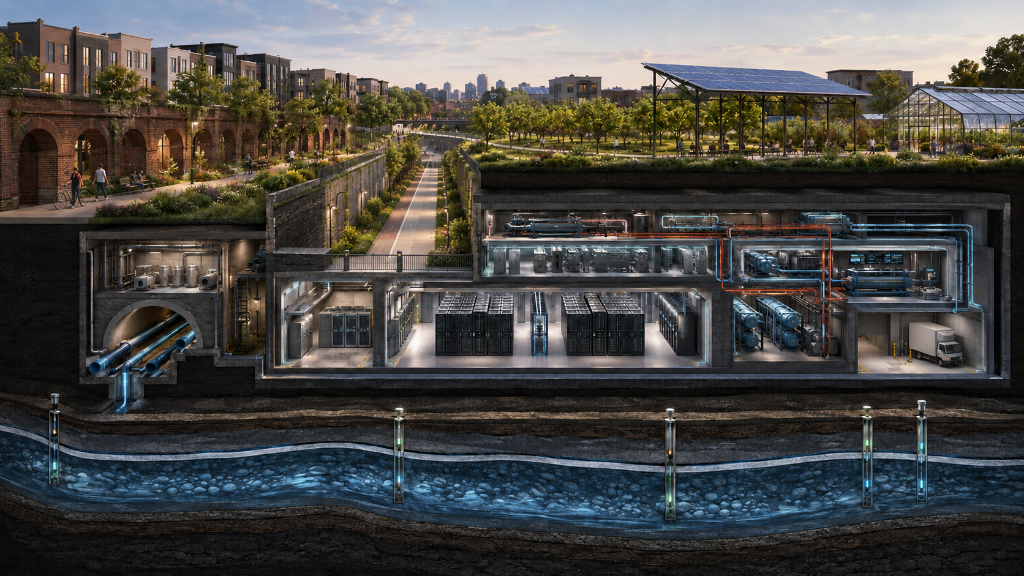
Conceptual cutaway of an adaptive-reuse former rail corridor, closed-loop data-facility cooling and a separately monitored subsurface-water zone under study.Concept rendering
Digital · Research · Underground

Below-Grade Opportunity & Digital Infrastructure

Part of the former rail alignment includes below-grade or underground conditions. Those areas may offer a naturally cooler environment for carefully designed data, research, utility or digital-infrastructure uses. The project is evaluating whether broadband, community laboratories, resilient communications and data infrastructure can be integrated without placing an incompatible industrial burden on nearby residents.

A potential data-center component is a concept under feasibility review. Its size, location, noise profile, energy demand, utility connection, heat management and community benefit must be established through engineering and approvals.

Required disclosure: Concept under hydrogeologic, environmental and engineering review. No water-use or cooling claim is final. Possible subsurface water, runoff pathways or aqueduct features remain subject to environmental, legal and engineering review.

Closed-Loop Water Recycling & Digital Cooling

How the subsurface trench cools digital infrastructure while recycling every drop — step by step.

Loop
🌍
Step 1 / 8
Earth's Natural Cooling

The below-grade trench stays a steady 50–55°F year-round — free geothermal cooling.

Just a few feet underground, the earth maintains a constant cool temperature regardless of the season. The former rail corridor's deep trench gives us access to this natural cooling reservoir — no electricity, no refrigerants, no emissions. The earth does the work.

Geothermal · Free · Always-on
Earth-Cooled
Free geothermal chilling
Cools Servers
Up to 80% less energy
Closed Loop
Same water, endlessly
Zero Discharge
No contaminated water

The closed loop: The earth cools the water → the water cools the servers → the earth re-cools the water → filtration purifies it → clean water is reused. The cycle never stops, and no contaminated water is ever left over. Technology in true harmony with the earth.

How the Pieces Reinforce One Another

Housing creates stable demand for neighborhood services and energy. Clean-energy systems can reduce operating costs and create new revenue through approved surplus sales. The orchard and market connect land stewardship with food access. Broadband, research and data infrastructure create educational and employment pathways.

01

193 W. Wellens Avenue

The Phase 1 anchor for energy, operations and community-development activity begins the first project phase.

A Phased, Evidence-Based Development

Each phase advances only on the basis of completed legal, technical and financing work.

Phase 1

Anchor Acquired — Predevelopment Continues

Site purchased — permits pending final L&I approval

COUD has acquired its anchor property. A Phase I Environmental Site Assessment and concept materials have been prepared. Further survey, environmental review, design, financing and permits remain necessary.

Phase 2 — Now Entering

Housing, Food and Community Infrastructure

Planning — site control and approvals required

Advance approved housing clusters, the orchard and growing spaces, community-market and service functions, safe paths, landscape restoration, local hiring and workforce programs. Corridor parcel identification, title, survey and environmental review proceed as the project expands outward from the secured Phase 1 anchor. Construction occurs only on legally controlled and properly permitted sites.

Phase 3

Renewable Energy and Digital Systems

Feasibility and transaction development

Deploy technology selected through feasibility work, complete utility and market arrangements, establish energy-product ownership, and evaluate broadband, research, data and below-grade infrastructure. Any subsurface-water cooling system requires its own technical, environmental, legal and permitting package.

Future Phases

Additional Corridors

Future opportunity — not yet included

Other abandoned railway segments and possible county extensions may be considered beginning in or after 2027. Each future phase requires a separate legal process, title and survey work, utility-territory analysis, environmental review, engineering, financing and approval. Nothing on this page suggests automatic ownership or rights beyond the approved Phase 1 geography.

Built for Community Benefit and Long-Term Resilience

Rooted in Resilience is a proposal to use one of North Philadelphia's most overlooked physical assets as a platform for connection.

More pathways to durable, energy-efficient housing.

Productive green space through orchard, growing and market uses.

Renewable generation and storage designed around local needs and lawful market participation.

Local and veteran hiring, apprenticeships and operating careers.

Broadband, learning, laboratory and research opportunities.

Environmental review and responsible treatment of subsurface resources.

A repeatable model for reconnecting communities along underused infrastructure.

The corridor can link homes with food, energy with opportunity, technology with training, and environmental responsibility with long-term neighborhood investment. The work begins at 193 W. Wellens Avenue, but its purpose is larger: build a community system in which each improvement makes the others stronger.

Project Status and Responsible Development

COUD is advancing a phased community-development plan. Completed preparation and preliminary responses are reported separately from proposed systems and work awaiting funding or approvals.

COUD has acquired its anchor property. Expansion depends on site control, survey, environmental review, engineering, utility arrangements, permits, financing and agreements.

Documented Progress
In Process
Under Study

Documented Progress

  • Anchor property acquired
  • Phase I Environmental Site Assessment prepared
  • Concept and predevelopment materials prepared
  • Preliminary 10 Gbps broadband pricing received
  • Housing Community Updates messaging verification completed

In Process

  • Site and boundary verification
  • Survey and environmental follow-up
  • Modular and precast feasibility discussions
  • Tree-care site-visit coordination
  • Housing-counseling approval preparation
  • Financing and permit requirements

Under Study

  • Three coordinated microgrids and storage
  • Renewables and potential heat recovery
  • Broadband routing and IT infrastructure
  • Below-grade conditions and water management
  • Final housing layout and unit count
  • Youth and local workforce pathways

Frequently Asked Questions

Plain answers to common questions about the project scope and status.

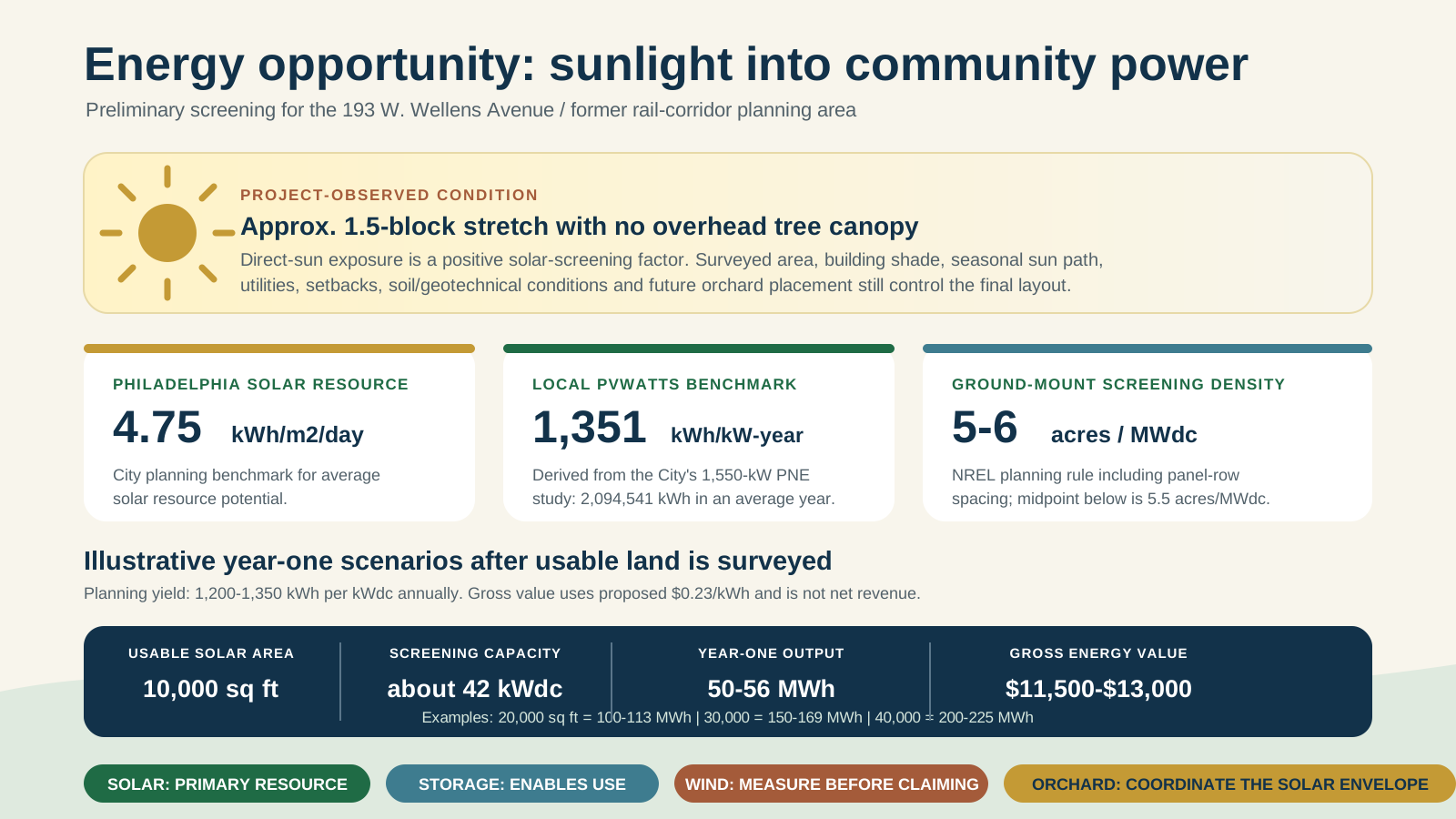
Energy opportunity: sunlight into community power — Philadelphia solar resource, PVWatts benchmark, ground-mount screening density, and illustrative year-one scenarios.
Technology-Neutral Portfolio

A Renewable-Energy Portfolio

Solar is the leading near-term opportunity, but the strategy remains technology-neutral. The project separates commercially available systems from site-pilot and research tracks.

Commercial
Solar — Primary Track

Ground-mounted photovoltaic panels on the ~1.5-block open stretch with no overhead tree canopy. Philadelphia benchmark: 4.75 kWh/m²/day. Planning yield: 1,200–1,350 kWh per installed kWdc annually.

Commercial
Battery Storage

Preserves solar energy for local use, supports resilience reserves, and enables export of only the verified surplus. Near-term: UL 9540-listed systems. Flow-battery track under evaluation for long-duration storage.

Site pilot
Distributed Wind

Philadelphia is in a low wind-resource class (~4.5 m/s at 30 m). Requires hub-height measurement, structural review, zoning, noise and wildlife analysis before any production claim.

Research watchlist
Efficiency & Other Technologies

Ground-source heat loops, agrivoltaics, nighttime radiative cooling (~50–350 mW/m²) and atmospheric water harvesting. Each piloted at small scale only; none counted as firm corridor capacity until commercially verified.

Coordinating Solar with the Orchard

The site is organized into three complementary planning zones. The final layout will protect tree root zones, food safety, panel access, drainage and long-term maintenance.

☀️
Solar-priority areas

Strongest measured solar exposure — panels, electrical equipment, safe operating clearances.

🌳
Orchard & edible landscape

Fruit trees, raised beds or containerized growing after soil, water and environmental review.

🌿
Dual-use transition (agrivoltaics)

Pollinator habitat, native planting and compatible low-growing agriculture between solar rows.

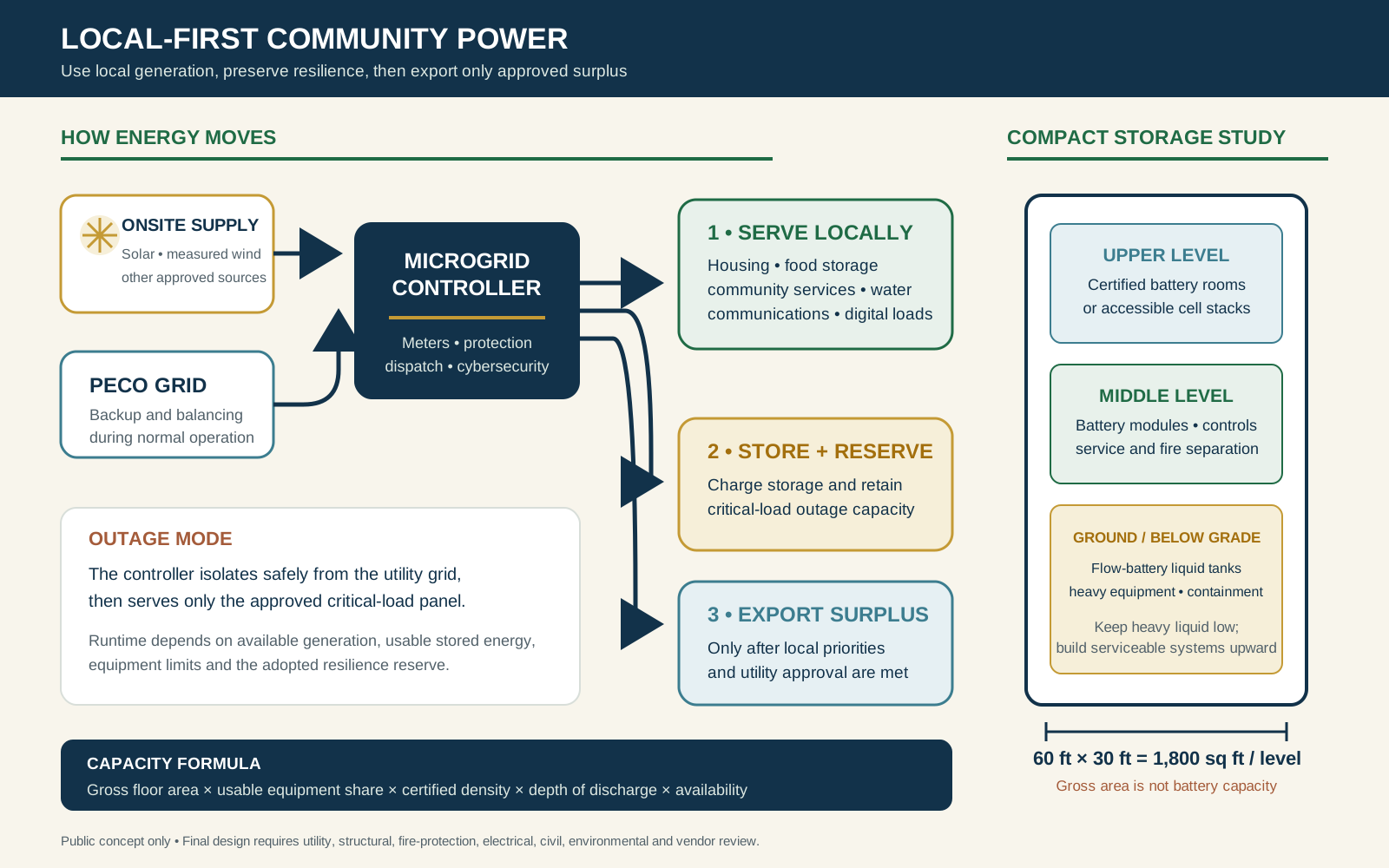
Local-first community power: how energy moves from onsite supply and PECO grid through a microgrid controller into serve-locally, store-and-reserve, and export-surplus priorities, plus the compact vertical storage study and capacity formula.
Reference

Understanding the Measurements

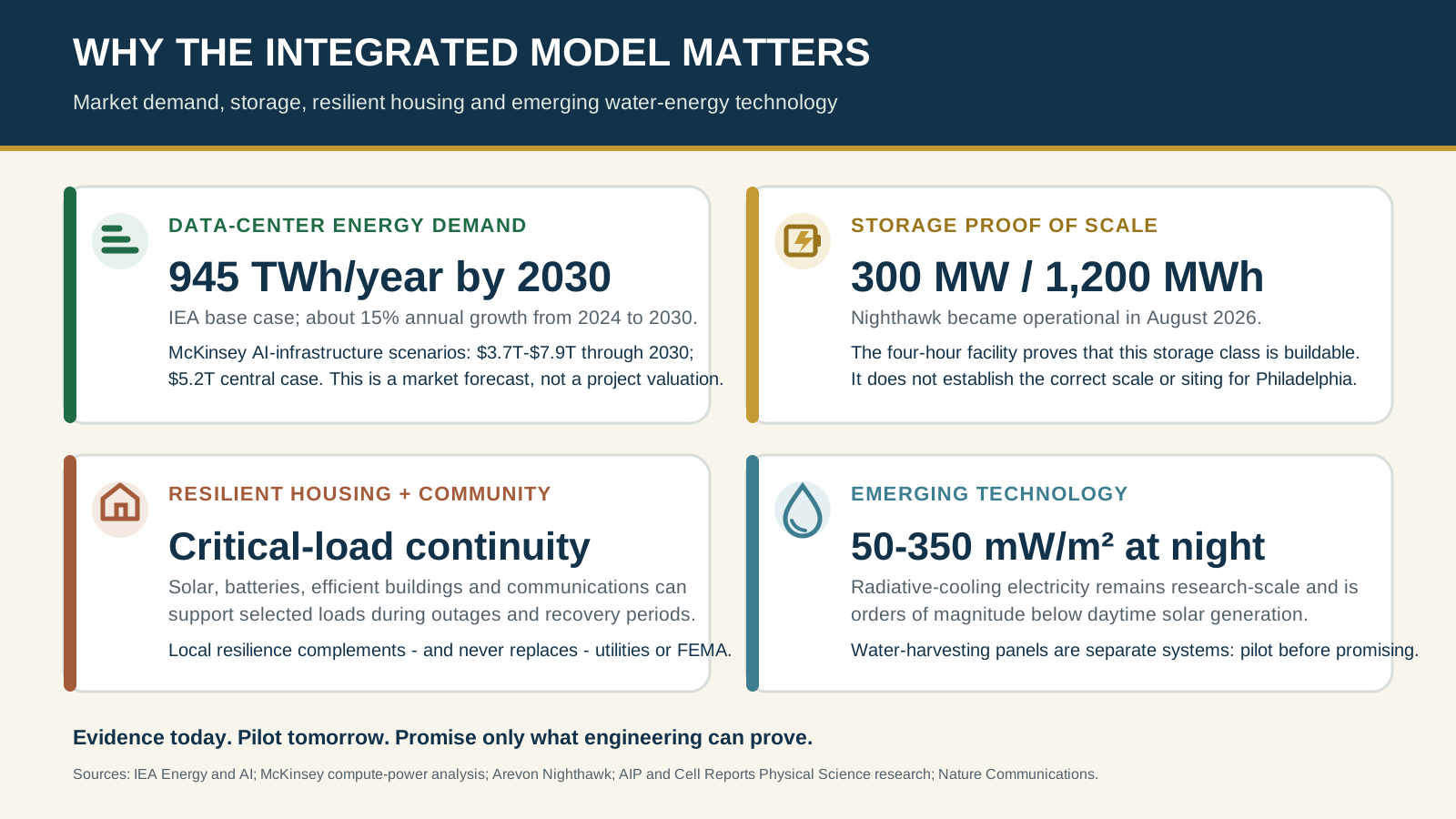
Why the integrated model matters: data-center energy demand, storage proof of scale, resilient housing and community, and emerging technology — with sources.
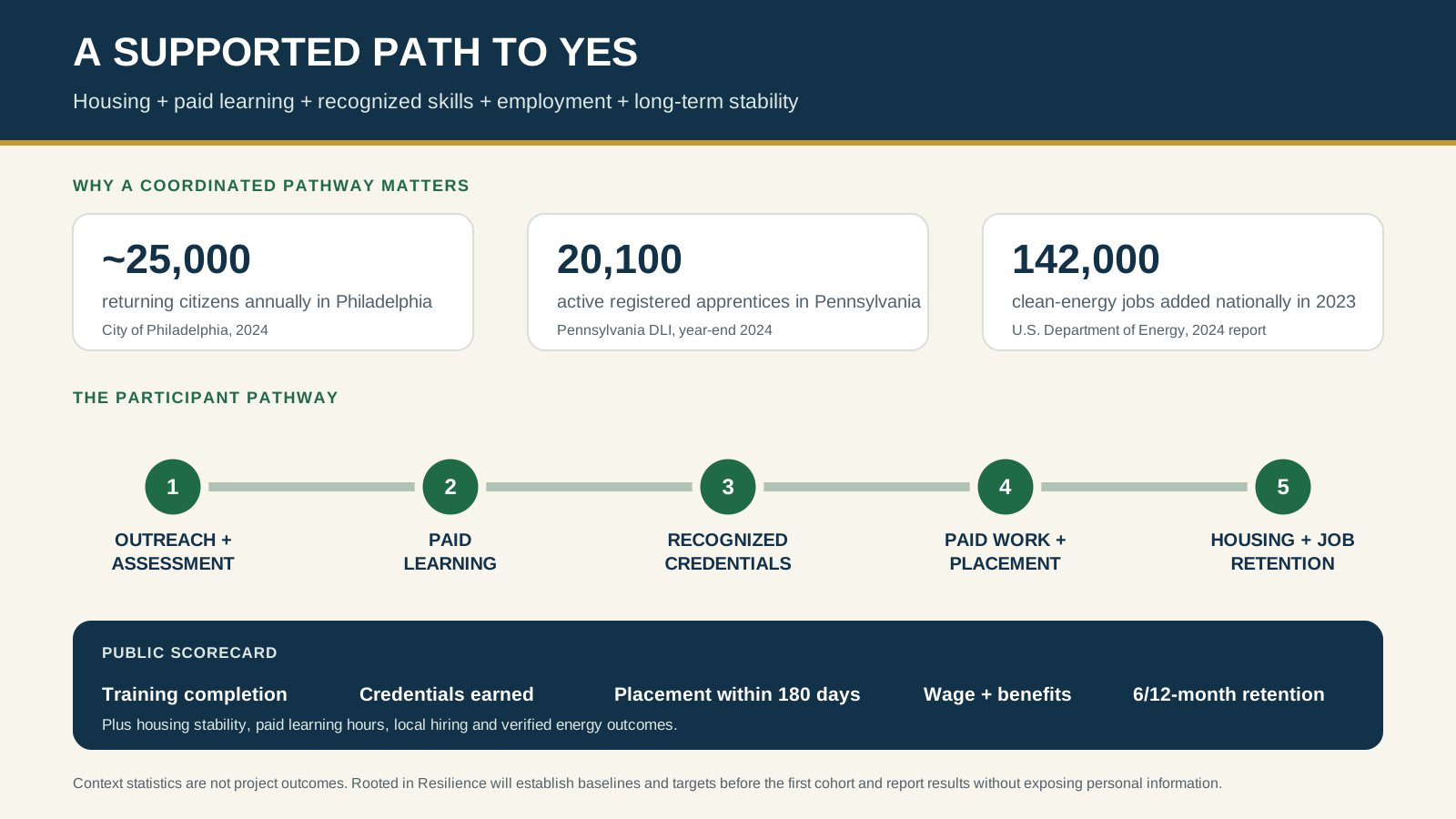
A supported path to yes: why a coordinated pathway matters, the participant pathway from outreach to housing and job retention, and the public scorecard.
From Opportunity to an Operating System

Seven Measurable Development Stages

1Survey & resource measurement
2Environmental & civil review
3Electrical & interconnection studies
4Microgrid & storage architecture
5Engineering & production modeling
6Commercial structure
7Permitting & phased construction
Responsible development means measuring the opportunity before promising it. Every capacity figure remains subject to survey, engineering, environmental review, interconnection and definitive agreements.
Below-Grade Opportunity & Digital Infrastructure

The Trench Beneath the Corridor

The former rail corridor includes a long below-grade trench — a subsurface asset that most redevelopment plans overlook. Rooted in Resilience proposes using that trench to manage water, provide natural cooling, house digital infrastructure and connect clean renewable energy to low-income neighborhood homes — technology in true harmony with the earth.

Subsurface Water & Runoff Pathways

The former rail corridor sits on a long, narrow below-grade trench. Stormwater runoff, existing drainage pathways and potential aqueduct connections can be repurposed to capture, store and move water underground — keeping it out of overloaded city sewers and making it available for cooling and reuse.

Subsurface Water-Cooling System

Water stored below grade stays naturally cool year-round. A closed-loop subsurface cooling system can exchange heat with buildings, data infrastructure and community facilities — lowering summer cooling loads without evaporative waste or chemical refrigerants.

Digital Infrastructure

The trench can house broadband fiber, edge-computing nodes and research sensors alongside the water and energy systems. Below-grade placement protects equipment, reduces visual impact and creates new educational and employment pathways for the neighborhood.

Interactive Visualization

How the Water-Recycling Process Works

Follow water from stormwater capture through subsurface storage, cooling, filtration and purification — all the way to clean renewable energy powering low-income homes. No contaminated water is left over at any stage.

Corridor Water-Recycling System

CISTERNHEAT EXCHANGERFILTRATION🌱CLEAN REUSE12345✓ ZERO CONTAMINATED DISCHARGE
1
Rainwater Capture

Rain & stormwater runoff collected from the corridor surface and directed underground.

Permeable surfaces and bioswales along the corridor capture rainwater before it reaches overloaded city sewers.

Every drop is captured, cooled, filtered, purified and reused — or returned clean. No contaminated water is left over at any stage.

Research Watchlist

Efficiency & Other Technologies

Each of the following is piloted at small scale only; none is counted as firm corridor capacity until commercially verified. They are tracked here as emerging opportunities that could further reduce energy demand and water consumption.

Ground-Source Heat Loops

Closed-loop geothermal exchange using the corridor's stable subsurface temperature for efficient heating and cooling of nearby homes and facilities.

Agrivoltaics

Dual-use solar + agriculture — pollinator habitat and compatible low-growing food crops between elevated solar rows.

Nighttime Radiative Cooling

Passive cooling surfaces that emit heat to the cold sky at ~50–350 mW/m², reducing nighttime cooling demand without electricity.

Atmospheric Water Harvesting

Capturing clean water directly from humid air using sorbent or condensation systems — a potential supplementary water source.

Pilot-stage disclaimer: These technologies are shown as research opportunities, not committed capacity. Each requires site-specific measurement, engineering review and commercial verification before it is counted toward corridor output.

Technology in True Harmony with Earth

Clean Renewable Energy for Low-Income Homes

The subsurface water-cooling system lowers energy demand. Solar panels on the corridor generate clean power. The verified surplus — not promised, but measured — flows through the local-first microgrid to nearby low-income homes. Families get affordable, renewable electricity. The neighborhood gets resilient infrastructure. The earth gets a corridor that gives back instead of sitting abandoned.

Affordable Power

Lower energy bills for low-income households

Clean & Renewable

Solar + storage, zero fossil fuel on site

Earth-First Design

Water reused, land renewed, nothing wasted

Knowledge Hub

Resources & Downloads

Concept diagrams for the proposed community corridor. Final designs depend on engineering and approvals.

Visual Diagrams

Energy Potential Data

Energy Potential Data

Sunlight into community power — Philadelphia solar resource, PVWatts benchmark, ground-mount screening density, and illustrative year-one scenarios.

Local-First Microgrid

Local-First Microgrid

How energy moves from onsite supply and PECO grid through a microgrid controller into serve-locally, store-and-reserve, and export-surplus priorities.

Integrated Model Proof Points

Integrated Model Proof Points

Why the integrated model matters: data-center energy demand, storage proof of scale, resilient housing and community, and emerging technology — with sources.

Supported Path to Yes

Supported Path to Yes

A coordinated pathway from outreach to housing and job retention, plus the public scorecard.

Resources are provided for informational purposes only and do not constitute legal, financial, or professional advice. Program availability is subject to funding, approvals, and regulatory compliance.

Volunteer

Join the Resilience Network

Tell us how you'd like to help and when you're available.

Get Involved

Help Build the Corridor

We welcome conversations with housing partners, renewable-energy developers, engineers, environmental specialists, workforce organizations, community institutions, responsible investors and public agencies that can help move a carefully phased plan into completed community assets.

📍 193 W. Wellens Avenue, Philadelphia, PA 19120

✉️ universaledivinity@gmail.com

No account or login required to contact us.

No account required. Your information is kept private.

Center of Universal Divinity
193 W. Wellens Avenue, Philadelphia, PA 19120
215-280-0789universaledivinity@gmail.com
Project Status Disclaimer: The COUD Resilient Communities Project is a phased initiative. COUD has acquired its anchor property. Expansion and construction remain subject to site control, survey, environmental review, engineering, permits, financing and agreements. Capacities, costs and schedules remain preliminary.
© 2026 Center of Universal Divinity. All rights reserved. | Rooted in Resilience